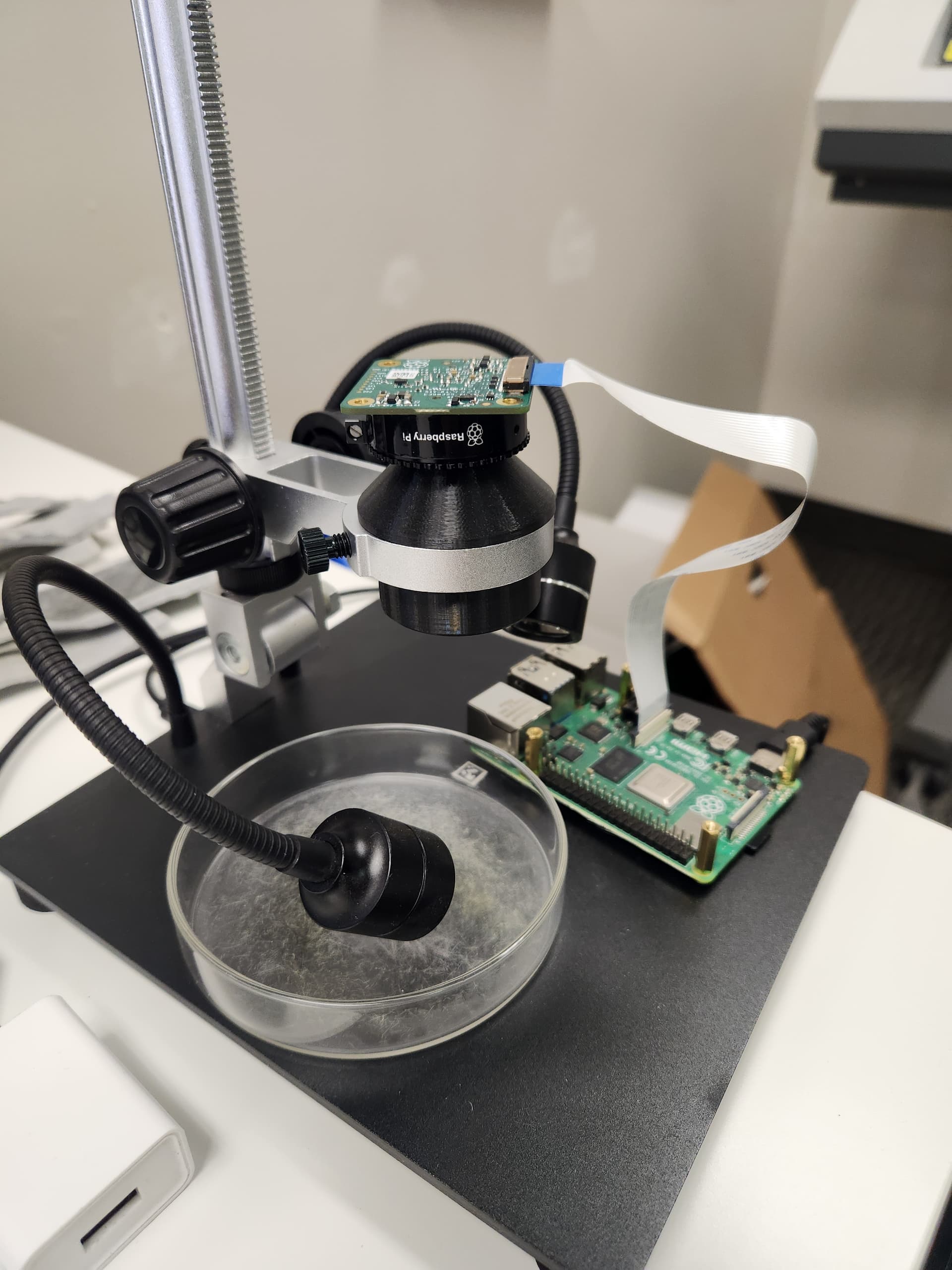
I am a new OpenFlexure user and recently set up an OFM with the high-resolution option for my work. I work for a composite products manufacturer and we wanted a better way to examine glass fibers in as-molded products. The primary purpose for us is to survey the distribution of fiber lengths (anywhere from 2mm to 18mm). I was drawn to the OFM because of its low cost and its open-source nature, so we could customize it to our needs.
I did some initial optics tests to decide on an objective lens, using a modified version of the high-resolution optics module that would fit our existing digital microscope focus mount. I was going to wait for the 12mm achromat lens to come in, but I noticed I could see quite well with the 4X objective alone, and didn’t think much of it. I used a Raspberry Pi HQ camera that we already had, and rested it on top of the modified optics module for some quick tests. With everything resting on the focuser, I was easily able to get good focused images of glass fibers, with a good field of view. The objective we purchased can be found here: AmScope 4X Plan Achromatic Objective
Fast forward to the microscope assembly. I purchased the kit from IO Rodeo, and I was impressed with their quality. The only hitch I had was with seating the illumination condenser lens, which didn’t click into place initially because I had it on a bit of an angle. I adjusted that, and as best I can tell it is oriented correctly now, using the print layer lines as a reference.
When I got the live view going, two things stuck out immediately:
- Only a circle in the center of the view was illuminated. I am familiar with vignetting from my astrophotography hobby, but it was a stark boundary. None of the example pictures from the OpenFlexure site showed anything close to that kind of contrast (full black all around, and so bright in the middle nothing could be seen).
- No matter what z location I chose, I could not bring the fibers into focus. Only when I removed the illumination module and raised it high enough that the dovetail was fully out of its counterpart could I get any sort of focus.
Just as a side observation, I also realized how big the difference is between the RP camera and the RP HQ camera when it comes to field of view. I will be exploring options to switch over to the HQ camera to be more compatible with our use case.
Right now I don’t know what I don’t know, so I’m hoping somebody who has worked on a similar setup could point me in the right direction. I have a few questions I hope to get answered:
- Is there anything obviously incompatible between the objective lens I chose and the assumed optics of the OFM?
- Is it possible I have seated the condenser lens incorrectly, leading to the strange illumination boundary? Or is this expected, given my objective?
Hi @ryantheengineer that is an interesting application. Could you post some pictures of your set-up?
I am not quite clear from your post whether you have now got the achromatic tube lens in the optics module. If you have not, then that is likely to be a big part of the issue.
If you have the tube lens in place then the most likely cause of your issue is the 4x lens. This has a very large field of view. The illumination on the OpenFlexure microscope is designed for high resolution 40x to 100x objectives. Those lenses need a very large angle of illumination to fill the NA of the lens, but only need a small illuminated area. It works well for 20x (or the low-cost optics which is equivalent to 20x), but at 10x it is difficult to illuminate the whole field of view with the focussed illumination. Of course it is possible to move the illumination back away from the sample to increase the illuminated area. This makes the angles of the light wrong at the sample and at the lens, which will degrade the resolution that you can obtain, however for a 4x lens this is less critical.
For a large field of view such as in your application there is another recent thread on different optics options, Refletion microscope without beam splitter.
Hi @WilliamW, thank you so much for your prompt and helpful reply. I got sick the evening after posting my question, and I’ve just gotten back to work so I will try to make more sense of things now.
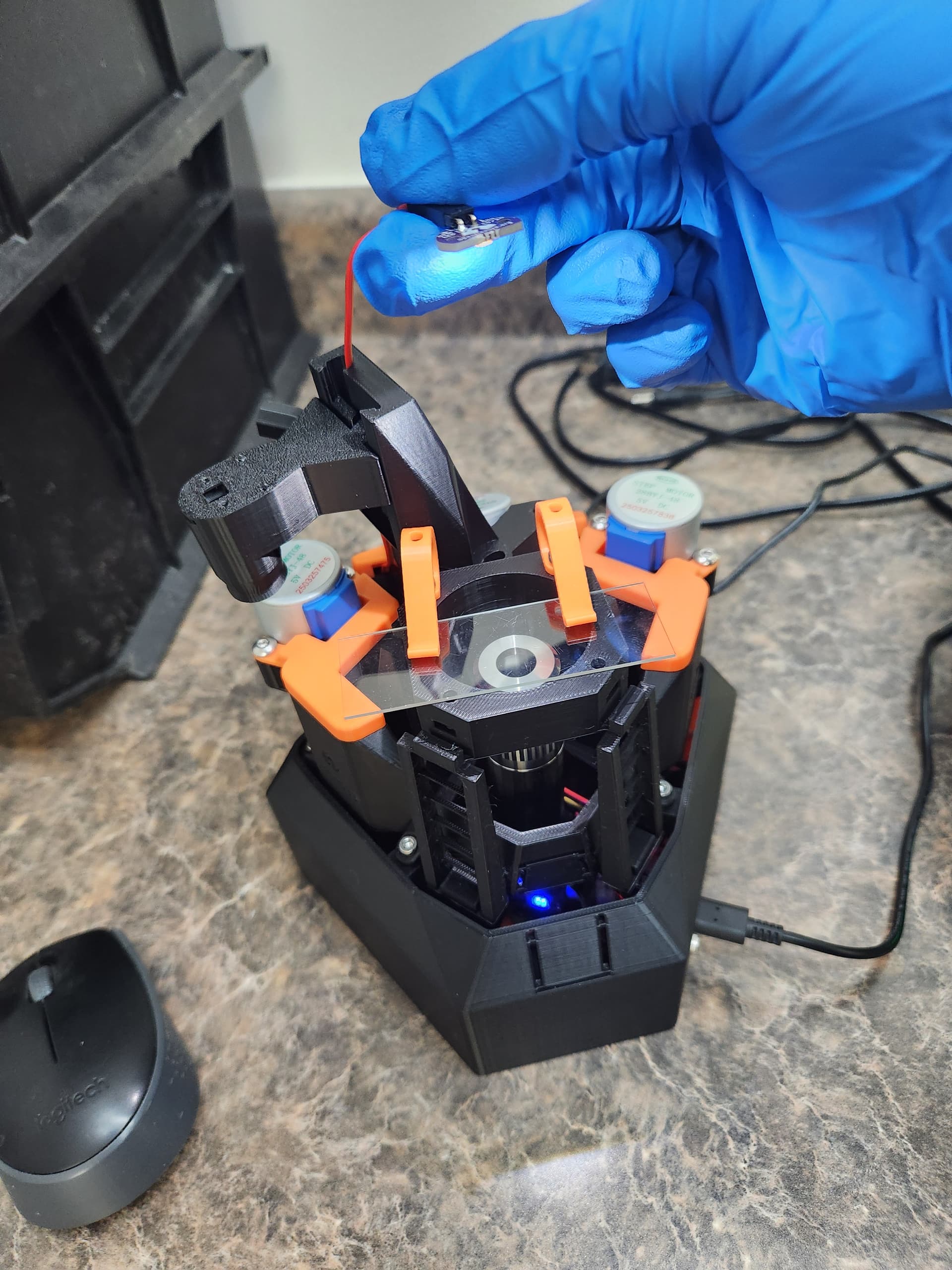
To clarify my setup, my benchtop test did not include the achromatic tube lens, but my OFM does have it installed. This is shown (without the objective lens installed) in the following image:
I’ve tried playing with the lighting distance to get something sort of in focus, but it’s not very usable. Here are some images that show about how far I’ve been holding the illumination, and a picture of the view I get on my screen.
I took a look at the other thread you linked, and I gave the flashlight approach a try, without success. I was able to show the presence of a few fibers, but it was so out of focus that I could barely see them against the dark background.
I don’t remember much from optics in my early physics classes, so I’m a little confused at what’s happening and my options to deal with it. Ideally I would love the option to get brightfield or darkfield images, so I’ve been looking further at the LED matrix lighting and Delta stage, but I would love to hear an experienced take on what is necessary to get my setup to work.
With the LED and no lens the illuminated area is huge and that is not the problem.
It looks most like a vignetting from the field of view of the objective, and it is off-centre. If that is not a defect in the lens, then it suggests that something in the optics module is not straight - the objective, the tube lens (the achromatic lens), or the camera.
The last image where I showed glass fibers was the best image I could get while holding the light high above the OFM. It’s not so much vignetting as it is misalignment of the light with the optical train.
That being said, I believe I’ve found my problem, which is twofold:
- The stock lighting is simply too bright for my objective. I removed it and used the room lighting instead, and I was able to get clearer images.
- The point of focus of my objective is about 2.5mm higher than expected, so the Z travel is insufficient to bring my target into focus.
I’m not sure why #2 would be the case, as I thought DIN-standard objectives all have the same parfocal distance. In any case, I was already thinking about modifying the main flexure to allow more travel, so I’ll be looking at adjusting the optics positioning as well.
There are a lot of non-standard par-focal distance objectives. This is particularly the case for low magnification or for ‘metallurgical’ objectives.
The tube length is 160mm on the specs. And it’s “DIN standard” so parfocal should be 45mm.
If it was 35mm parfocal then it would need to be a lot closer than you are saying I would think.
This might be that the effective path length inside the optics module is wrong. Are you sure the achromatic tube lens is 50mm focal length? And are you sure it is fully srated into the module?
@j.stirling The tube length is evidently still 160mm. I ordered my achromatic tube lens from AliExpress and it was listed as 50mm focal length. I have verified that it is fully seated into the optics module.
I ended up altering the parfocal distance parameter in the OpenSCAD and printing a version of the RMS optics module with a 47.5mm parfocal distance. I don’t know why my objective is off by that much compared to the DIN standard, but it solved my problem in any case.
I’m glad that everything was parametric enough for you to fix!
I would assume that it is more likely that the AliExpress vendor sent the wrong tube lens is the wrong focal length than Amscope objective is 2.5mm off the nominal parfocal length
The tube lens being wrong would change the effective tube length, and therefore the focus position (and therefore the parfocal length). Adjusting the optics module is a pragmatic solution. If I am correct in blaming the tube lens it will mean that the objective won’t do its plan correction as well because it is not at the perfect working length/tube lens. But with 4x this shouldn’t matter much.
Just in case this is useful, if you’re working at low magnification the condenser lens is possibly unhelpful. If you remove the condenser lens, this might already improve things. It’s possible that replacing the condenser lens with a diffuser (e.g. a disc of paper or thin white plastic) might be better than the small-area illumination you get with the condenser.
@r.w.bowman I ended up changing out the illumination entirely. You can see what I did on this thread.
Looking back on the parfocal issues, I think what happened is I didn’t understand the focus point to be at the bottom of the slide, or the exact top surface of the XY stage. My slides are 2.5mm thick, and I have to put the glass fibers on the top surface for my setup to work. So adjusting the parfocal length simply let me put the focus on the top surface of the slide.
Thanks for the explanation. This makes a lot of sense.